Jeep's Independent-Front Wrangler Is a Concession to the Bronco
Jeep's first independent-front Wrangler arrives wrapped in SRT desert hardware. Read the sales numbers and it looks less like a stunt than a concession to the Bronco.
Contents · 7 parts
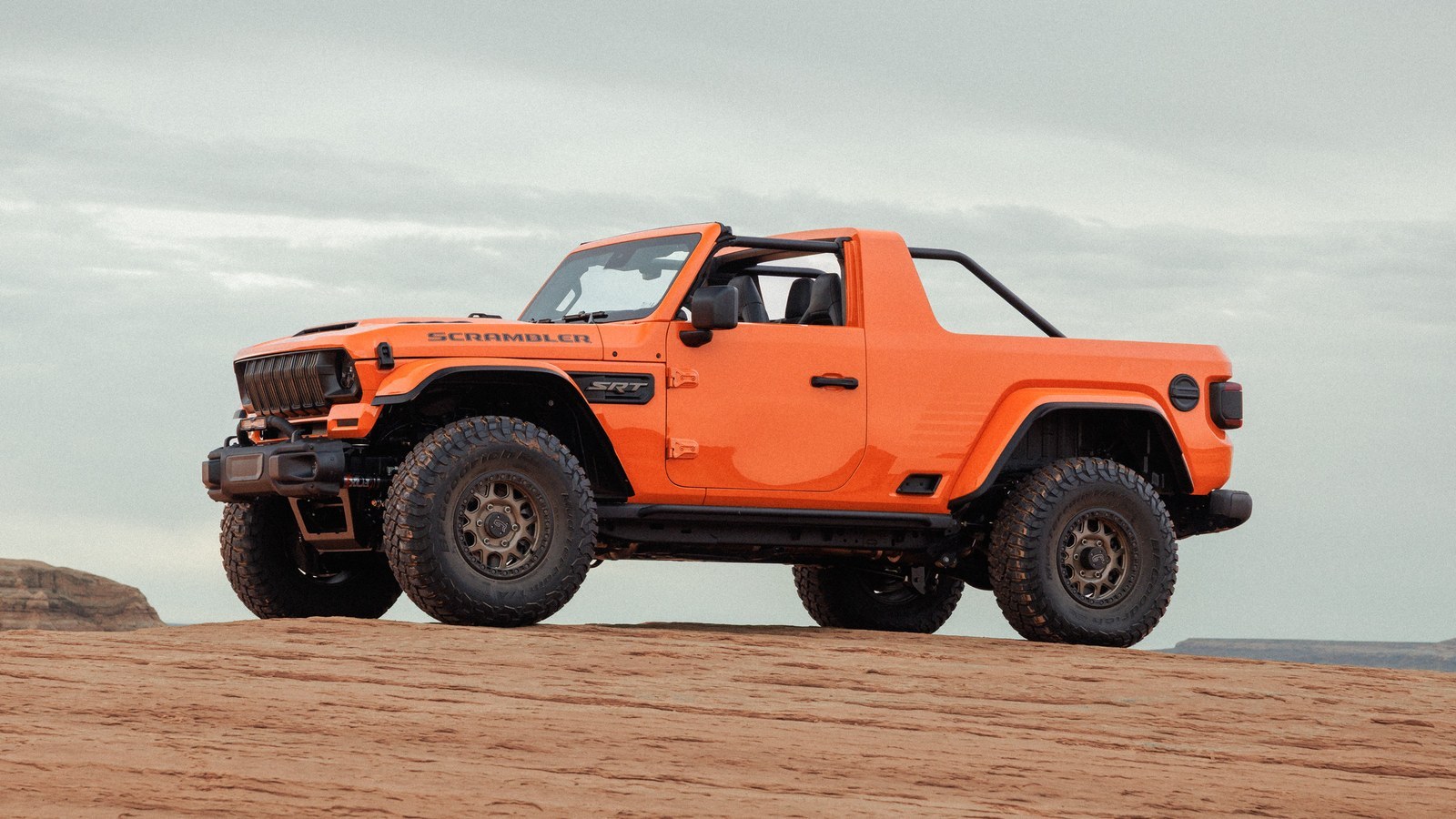
Jeep has put independent front suspension under a Wrangler for the first time. It sits on the Wrangler Scrambler SRT Concept, shown at SEMA on November 2 with a 470-hp 6.4-liter Hemi V8.
Here's what the headlines miss: the front axle is a bigger story than the engine. Every Wrangler so far has ridden on a solid front axle, and that axle has been the model's core engineering argument, the reason owners put up with a wandering highway ride.
I think the Scrambler is Jeep conceding the point the Ford Bronco has been making in showrooms since 2021. SRT simply dresses the concession in desert-racing hardware so it doesn't look like one.
SRT rebuilt a Wrangler around a race-bred front end
According to Stellantis's announcement, the concept starts from a Wrangler chassis and is reshaped from the A-pillar back, with longer doors, an integrated pickup bed, a structural roll cage and a silhouette borrowed from the 1981 CJ-8 Scrambler. The front end is a high-travel independent setup from Currie Industries, developed with off-road racer Casey Currie and derived from the Jeep Striker Concept system that Currie drove to a class win at the NORRA 500.
The spec sheet attached to the release fills in the rest: 14 inches of front wheel travel, 15 inches at the rear on a trophy-truck-style straight axle, 2.5-inch shocks at all four corners, 37-inch BFGoodrich mud-terrain tires, and 470 hp with 470 lb-ft from the 6.4-liter Hemi.
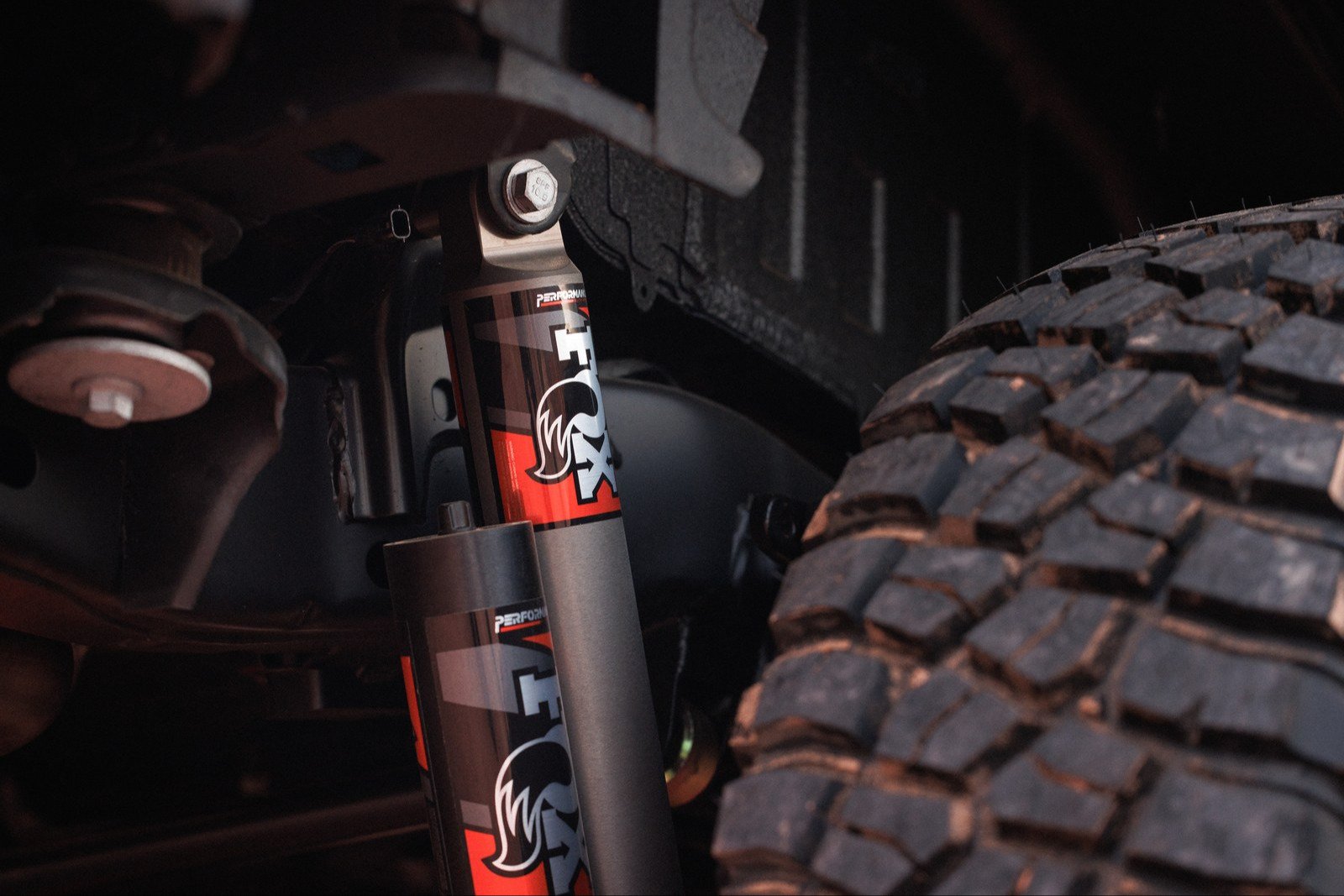
Officially, this is a concept. The Drive reports that it is in Stellantis's product plan and that Tim Kuniskis, who runs the American brands and SRT, showed it to a small group of journalists in May. Jeep has announced no timeline, price or production decision, and I'm treating it as a concept until that changes.
The solid axle was the Wrangler's whole argument
A solid front axle ties both front wheels together. On rocks, that means articulation and toughness. On pavement, it means more unsprung weight, vaguer steering and the side-to-side head toss every Wrangler owner knows. Jeep has sold that trade for generations, and buyers took it because the alternative sounded like a Jeep that wasn't quite a Jeep.
Ford built the 2021 Bronco around the other answer: independent front suspension as standard, a solid axle only at the rear. The logic was blunt. These vehicles spend most of their lives on roads, so make the road part good and engineer enough travel to stay credible off them.
At SEMA, Kuniskis made the engineering case in his own words. Per The Drive, he told the crowd that the new front end would take high-speed desert whoops better than any solid axle could. Swap the desert for a broken interstate and you have Ford's 2021 sales pitch, delivered by Jeep's own boss.
The sales gap is closing, and Jeep can count
Wrangler still outsells Bronco. The question is by how much, and the answer keeps getting smaller. In 2024, Jeep sold 151,163 Wranglers in the U.S. against 109,172 Broncos. In 2025, Bronco jumped 33.7% to 146,007, according to Ford's year-end report, while Wrangler grew about 11% to 167,322. Through September 2026, Stellantis reports 131,011 Wranglers, and Ford reports a record 114,956 Broncos.
| 2024 | 2025 | Jan–Sep 2025 | Jan–Sep 2026 | |
|---|---|---|---|---|
| Jeep Wrangler (U.S.) | 151,163 | 167,322 | 128,054 | 131,011 |
| Ford Bronco (U.S.) | 109,172 | 146,007 | 109,921 | 114,956 |
| Wrangler's lead | 41,991 | 21,315 | 18,133 | 16,055 |
| Wranglers sold per Bronco | 1.38 | 1.15 | 1.16 | 1.14 |
The Wrangler's lead halved in a single year and is still narrowing: Bronco is up about 4.6% through nine months, Wrangler about 2.3%. Ford's figure for January–September 2025 is its full-year total minus the fourth quarter; everything else comes straight from the two companies' reports.
Sales aren't only about suspension. Pricing, incentives, trim mix and the Bronco's newer design all play a part, and I can't isolate the axle from them. But when a rival builds its engineering case around the one thing you refuse to do and keeps gaining on you, the question inside Jeep stops being whether independent front suspension is heresy. It becomes where to introduce it first.
An SRT badge is the safest place to break a rule
That is why I don't think the badge is an accident. A desert runner with a Hemi, 37-inch tires and a racer's name on the hardware lets Jeep introduce independent front suspension as a performance upgrade rather than a retreat. Nobody calls a trophy-truck front end soft. It also lets the brand watch how its most loyal buyers react before the idea reaches the volume trims.
The V8 plays the same role. Jeep gave the V8 Wrangler a pricey send-off not long ago; now the Hemi is back, on the very model that breaks the axle rule. Few enthusiasts will argue with a front end that arrives with 470 hp attached.
The rest of the concept is aimed at the Bronco buyer too. The rear seats are removable or reversible by 180 degrees, and with them out the bed grows from 40 to 71 inches, per the spec sheet. That is lifestyle-truck flexibility, not rock-crawler purity.
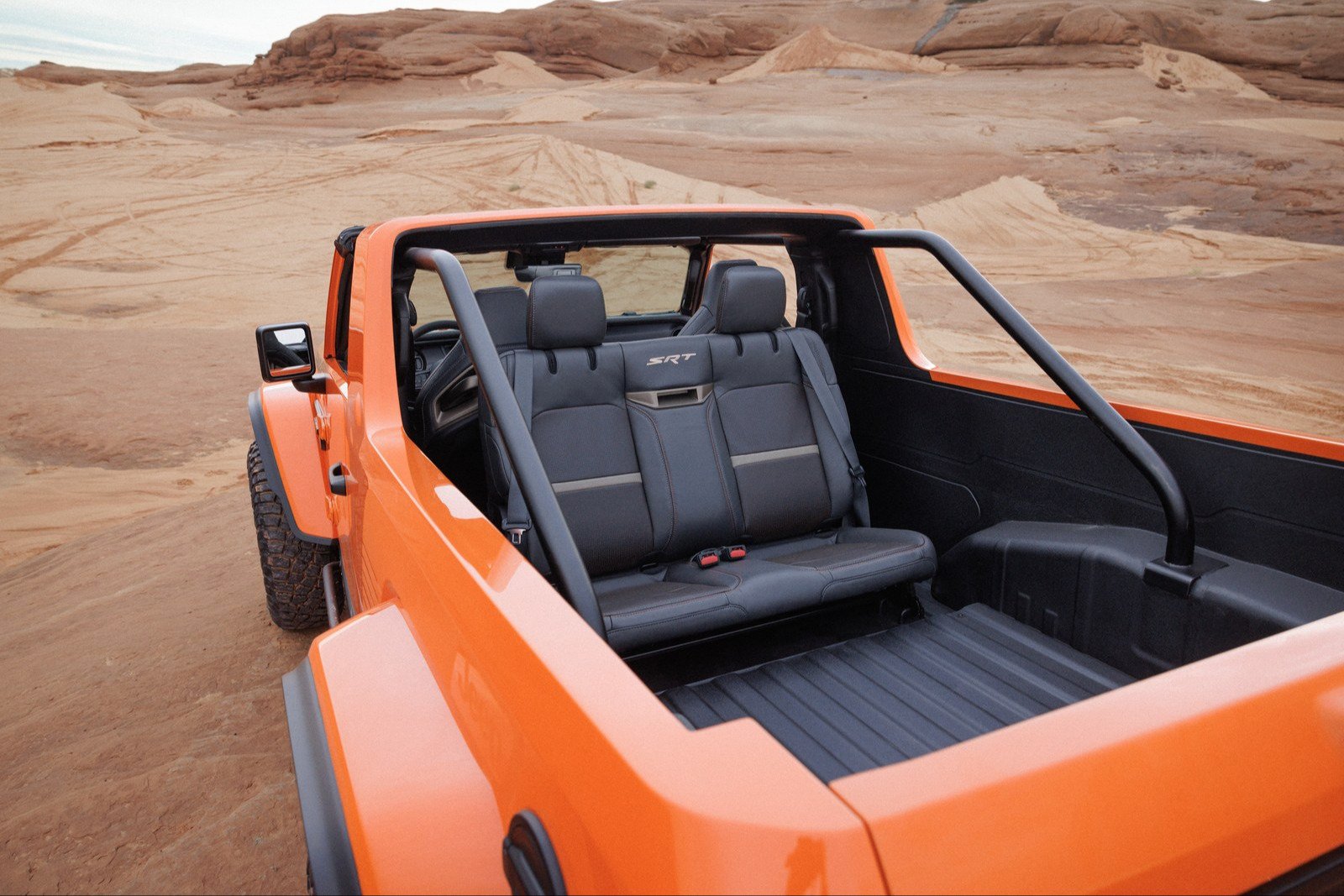
The case against my view
The strongest objection is that I'm reading a product strategy into a one-off. The Scrambler is a two-door, V8, desert-spec SRT concept. Kuniskis called it "mission specific," and nothing in Jeep's release says the regular Wrangler is getting independent front suspension. If this reaches showrooms, the likeliest outcome is a niche flagship next to a Rubicon that keeps its solid axle. On that reading, Jeep hasn't conceded anything; it has added a desert toy.
That is a fair reading, and on the narrow question of the Rubicon it may well be right. But it doesn't undo the concession. Jeep's long-standing position was that a real Wrangler rides on a solid front axle. Engineering, racing and validating an independent front end for a Wrangler-based vehicle, and putting it in the product plan if The Drive's reporting holds, means Jeep now owns both the hardware and the argument for it. Once a part exists inside a platform, it tends to travel. The Rubicon can keep its axle; the Wrangler's identity has already moved. I made a similar point about Ford's own fine print in my column on the Bronco's 3.0 V6: what a company engineers matters more than what it says on stage.
What would change my mind
If Jeep confirms the Scrambler for production with independent front suspension reserved strictly for SRT, and the Wrangler lineups announced for the 2027 and 2028 model years stay solid-axle across every other trim, I'll accept that this was a halo exercise rather than a shift.
I'd also reconsider if the sales line turns. If the full-year 2026 reports that Stellantis and Ford publish in early January show Wrangler's lead widening again, back above 30,000 units, the pressure I'm describing isn't there, and Jeep has far less reason to move.
And if Jeep engineers publicly describe the setup as unsuitable for everyday road use rather than simply desert-tuned, that would undercut the idea that this hardware is a template for anything else.
My read
The Scrambler SRT is a concept, and the solid axle isn't dead. But Jeep has just spent engineering money proving a Wrangler can ride on an independent front end, after decades of selling the opposite, and the shrinking Bronco gap explains the timing. My bet is that within two years of this truck reaching showrooms, independent front suspension shows up on a Wrangler that doesn't wear an SRT badge.